You get the adaptations behind a high VO2max, organ by organ, with the studies that show them. You also learn which of these changes has been proven to protect, which are plausible but unproven, and how much of VO2max people bring with them from birth.
In short
A high VO2max goes hand in hand with markedly lower mortality : in a cohort of 122,007 people referred for treadmill testing, the risk of death in the lowest fitness quarter was about five times that of the fittest group, the top 2 percent (Mandsager 2018). Fitness there was estimated from treadmill performance, not measured by gas analysis. You know this link. Less often explained is where it comes from. VO2max is a single number, measured at the end of a graded test, and it contains adaptations in heart, blood, vessels, muscle, metabolism and brain that training demonstrably triggers. For one of them, blood pressure, it has been shown that lowering it lowers mortality, though with medication in people at high risk. The others are plausible mediators : measurably changed by training, linked to disease risk, their contribution to lifespan is open. At the same time, about half of VO2max runs in families, which makes it also a marker of health people already bring along. Knowing the adaptations tells you what training actually does, even when the number barely moves.
1. The link : why VO2max counts for so much
The largest single analysis comes from the Cleveland Clinic : 122,007 adults who did a treadmill exercise test between 1991 and 2014, followed for a median of 8.4 years (Mandsager 2018). The researchers grouped them by fitness relative to their age and sex, from the lowest quarter up to an elite group, the top 2 percent. Those in the lowest quarter had about five times the risk of death of the elite group. Read the other way round : in the elite group the risk was about 80 percent lower.
Reference 1 = no additional risk (elite group, or people without the respective condition). Low fitness = lowest quarter for age and sex, elite = top 2 percent. The fitness bar compares the two extreme groups, the other bars compare present against absent ; the lengths are therefore not a direct comparison of how dangerous each factor is. Source : Mandsager 2018, n = 122,007. Observed association, not proof of cause.
The classic risk factors sat in the same model : smoking went with 1.41 times the risk, diabetes with 1.40, coronary artery disease with 1.29. The authors write that the link with fitness is comparable to or greater than that of these factors. And it does not level off at the top : even compared with the second-best group, the elite group still had about a 23 percent lower risk.
A meta-analysis of 33 studies with 102,980 healthy participants gives a figure that is easy to remember : each additional MET of fitness, about 3.5 ml/kg/min of VO2max, went with about 13 percent lower risk of death (Kodama 2009). That is what makes VO2max such an informative marker : the link already shows between the lower levels, not only at the top. Whether raising your own VO2max lowers risk to the same degree is something these observational data cannot show.
Both studies show associations, not causes. In the Cleveland cohort, fitness was estimated from treadmill performance, and the participants were people referred for testing. How much of the effect training itself produces and how much is health people bring along is covered in section 5. First, the question this article is about : where does this link come from?
2. What VO2max measures
VO2max is the largest amount of oxygen your body can take up and use per minute. Physiologically it is the product of two quantities : maximal cardiac output, that is how much blood the heart ejects per minute, and the oxygen difference between artery and vein, that is how much oxygen the muscles extract from the blood flowing past (Faricier 2025). Cardiac output in turn is heart rate times stroke volume.
This equation explains performance. It does not yet explain why a high value goes with a longer life. For that, you have to look behind the individual factors. How to place your own value is covered in Understanding your VO2max ; how to raise it, in Improving VO2max.
3. The number is a result
When a sedentary person starts regular endurance training, a whole chain of organs changes.
The heart becomes more compliant. In a randomised trial, previously inactive people around 53 years of age trained under supervision for two years ; 53 of 61 completed it. Their left heart chamber became less stiff (the stiffness constant fell from 0.072 to 0.051), filled more at the same pressure and ejected more blood per beat. VO2max rose by 18 percent, from 29.0 to 34.4 ml/kg/min ; in the control group it stayed the same (Howden 2018).
There is more blood. After six weeks of endurance training, 16 untrained young men had 8 percent more red blood cell volume and 6 percent more haemoglobin mass. When the researchers removed the extra blood again by phlebotomy, a large part of the VO2max gain disappeared as well, even though the muscle adaptations remained (Montero 2015).
The muscle remodels. Across many training studies, the content of mitochondria, the power plants of the cell, rose by 23 to 27 percent on average, and each muscle fibre gained about 10 to 15 percent more capillaries (Mølmen 2025).
In a study of younger and older adults, the rise in VO2max after twelve weeks was closely tied to cardiac output, and also to capillary density and a mitochondrial enzyme (Faricier 2025). VO2max therefore measures how well these parts work together. What is linked to the lower risk are the adaptations themselves.
4. The one proven case : blood pressure
For a single one of these adaptations, the whole chain is proven. Training lowers blood pressure : in an analysis of 270 randomised trials, endurance training lowered resting blood pressure by 4.5 mmHg systolic and 2.5 mmHg diastolic on average (Edwards 2023). And lowering blood pressure demonstrably lowers mortality : in the SPRINT trial of 9,361 people at high cardiovascular risk, the risk of death was 27 percent lower with more intensive blood pressure lowering (Wright 2015).
Two caveats belong here. SPRINT lowered blood pressure with medication and in high-risk people ; the size of that effect cannot be transferred to exercise. And how much of the protection from training runs via blood pressure is not known.
5. Cause or marker?
A high VO2max is both. The evidence allows the two parts to be told apart, though not to be quantified precisely.
Part of it is brought along. In the HERITAGE Family Study, family background explained at least half of the differences in baseline values of untrained people, although the authors themselves write that shared living conditions may overestimate this share (Bouchard 1998). The training response was 47 percent familial as well : after 20 weeks of identical training, VO2max rose by about 400 ml/min on average, barely at all in some and by more than a litre in others (Bouchard 1999). These are statements about differences between people. They do not mean that your own fitness is half fixed.
Genetics gives no uniform picture. Mendelian randomisation studies use genetic variants as a natural experiment. One found no effect of genetically determined VO2max on type 2 diabetes or genetically estimated longevity (Kjaergaard 2025). A second found favourable associations with arterial stiffness, heart rate variability, diastolic blood pressure and the inflammation marker CRP, but unfavourable ones with atrial fibrillation (Fornara 2026). A third found a lower risk of heart failure (Liang 2026). Important : these studies measure inborn fitness. They do not answer what training does.
The direct test is hard. In Generation 100, 1,567 people around 70 trained under supervision for five years. Compared with a control group that itself trained a lot and partly at high intensity, mortality did not fall significantly ; the interval training group showed only a trend (Stensvold 2020).
It follows that VO2max is both the result of protective adaptations and a marker of health brought along. Which share stands for which is open. That is exactly why it pays to know the adaptations themselves : they are what training influences.
Why does a high VO2max go with a lower risk of death?
Behind it are adaptations that are themselves linked to disease risk : a more compliant heart, more blood volume, lower blood pressure, more elastic vessels, more capillaries and mitochondria in muscle, better insulin action, less visceral fat. So far this has been shown causally for blood pressure. Part of the link also comes from healthy people being fitter to begin with.
Is VO2max inborn?
In part. In the HERITAGE study, family explained at least half of the differences in baseline values and just under half of the differences in the training response. It remains trainable nonetheless, into older age.
What happens in muscle when I train endurance?
On average, mitochondrial content rises by 23 to 27 percent and each muscle fibre gains 10 to 15 percent more capillaries. Capillaries grow mainly in the first weeks and in people coming from little training.
Does training help me if my VO2max barely rises?
The VO2max response varies greatly between individuals, and other responses run independently of it : in HERITAGE, almost half of the participants showed a strong response in at least one cardiovascular or metabolic measure and a weak one in another. A small VO2max gain therefore says little about the other adaptations.
This article is for information in the context of lifestyle coaching. It is not medical advice, not a diagnosis and not a recommendation for any individual case. The values given are study averages, not an expectation for any individual. Anyone with pre-existing conditions or on medication should clarify training volume and load with a doctor first. Felix Baier is neither a physician nor a German-licensed Heilpraktiker.
Ten adaptations, organ by organ : what training changes and what is proven about it
The second partFor heart and blood, vessels, muscle, metabolism and brain, the second part separates three things for each adaptation : the training trial that shows the change, the study that links the factor to disease, and how far the chain really reaches. It also covers two values that are often overrated, resting heart rate and CRP, and which training stimulus drives which adaptation, as far as the studies show it.
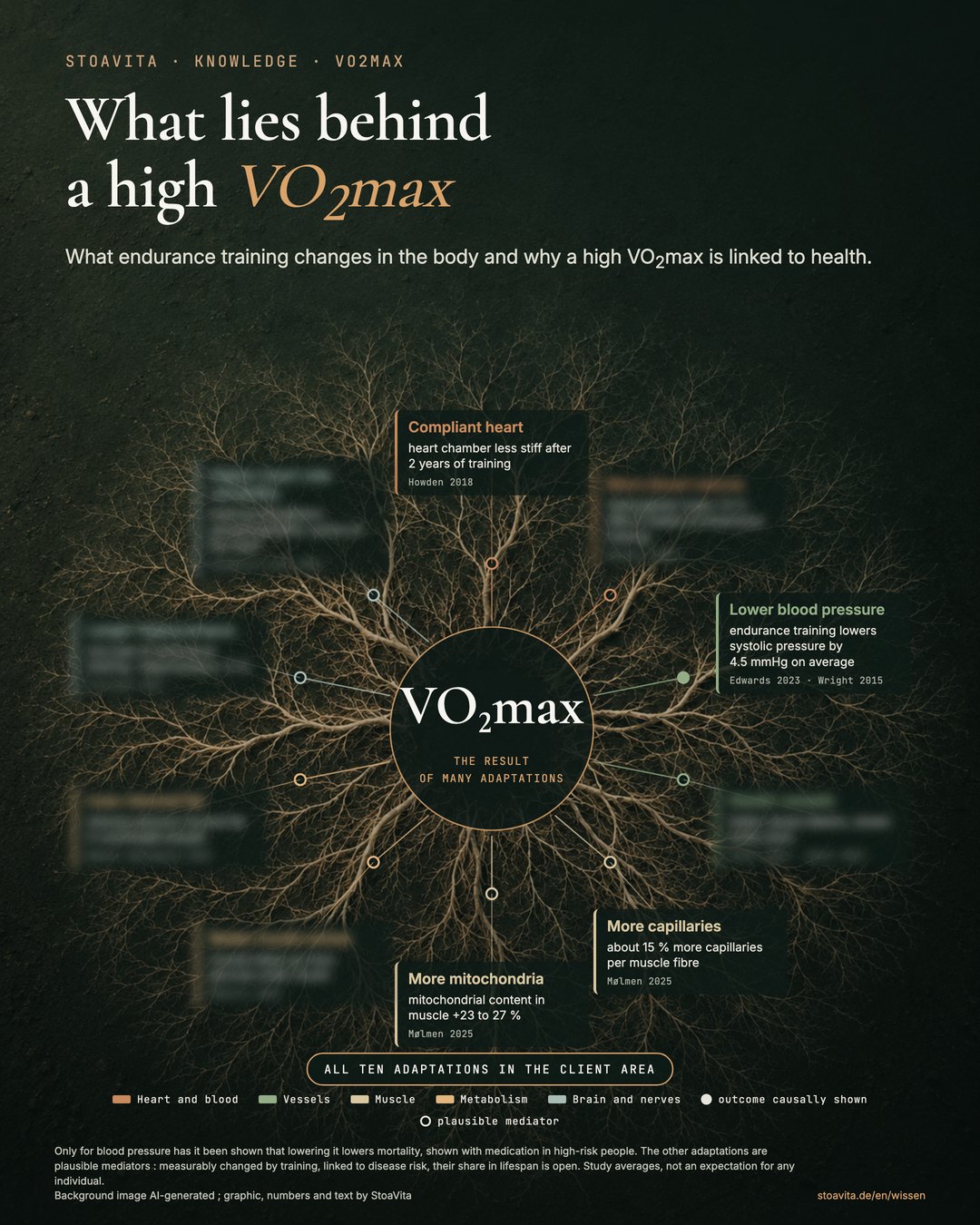
Ten adaptations on one page
Four of ten adaptations are readable here. All ten, each with study and evidence level, sharp and complete after signing in to the client area.
Sign in and view →The second part is for clients : all adaptations in detail, the training stimuli and the poster.
Up to this point the article covers the mechanism. What follows moves from the mechanism to your own values, and that part we keep for the people we work with.
- The whole picture on one poster : all ten adaptations with study and evidence level
- Heart and blood, vessels, muscle, metabolism, brain and nerves : for each adaptation the training evidence, the outcome evidence and the assessment
- Why endurance is not the strongest stimulus for blood pressure
- Resting heart rate and CRP : two values that are often overrated
- Which training stimulus drives which adaptation, only as far as proven
There is no self-service sign-up. Access comes with working together ; the first conversation is free and non-binding.
See what your training changes
We measure VO2max by cardiopulmonary exercise testing and the thresholds by lactate testing. The Longevity Check-up adds more than 70 biomarkers, determined by a specialist laboratory and put in context in a conversation.
Sources (primary literature and reviews, peer-reviewed)
- Mandsager K, Harb S, Cremer P et al. (2018). Association of Cardiorespiratory Fitness With Long-term Mortality Among Adults Undergoing Exercise Treadmill Testing. JAMA Netw Open 1(6):e183605. doi:10.1001/jamanetworkopen.2018.3605
- Kodama S, Saito K, Tanaka S et al. (2009). Cardiorespiratory fitness as a quantitative predictor of all-cause mortality and cardiovascular events in healthy men and women: a meta-analysis. JAMA 301(19):2024-2035. doi:10.1001/jama.2009.681
- Faricier R, Paterson DH, Murias JM (2025). Physiological Determinants of V̇O2max Increase with Endurance Training in a Group Including Older and Young Adults. Med Sci Sports Exerc 57(8):1790-1798. doi:10.1249/MSS.0000000000003707
- Howden EJ, Sarma S, Lawley JS et al. (2018). Reversing the Cardiac Effects of Sedentary Aging in Middle Age-A Randomized Controlled Trial: Implications For Heart Failure Prevention. Circulation 137(15):1549-1560. doi:10.1161/CIRCULATIONAHA.117.030617
- Montero D, Cathomen A, Jacobs RA et al. (2015). Haematological rather than skeletal muscle adaptations contribute to the increase in peak oxygen uptake induced by moderate endurance training. J Physiol 593(20):4677-88. doi:10.1113/JP270250
- Mølmen KS, Almquist NW, Skattebo Ø (2025). Effects of Exercise Training on Mitochondrial and Capillary Growth in Human Skeletal Muscle: A Systematic Review and Meta-Regression. Sports Med 55(1):115-144. doi:10.1007/s40279-024-02120-2
- Edwards JJ, Deenmamode AHP, Griffiths M et al. (2023). Exercise training and resting blood pressure: a large-scale pairwise and network meta-analysis of randomised controlled trials. Br J Sports Med 57(20):1317-1326. doi:10.1136/bjsports-2022-106503
- Wright JT Jr, Williamson JD, Whelton PK et al. (2015). A Randomized Trial of Intensive versus Standard Blood-Pressure Control. N Engl J Med 373(22):2103-16. doi:10.1056/NEJMoa1511939
- Bouchard C, Daw EW, Rice T et al. (1998). Familial resemblance for VO2max in the sedentary state: the HERITAGE family study. Med Sci Sports Exerc 30(2):252-8. doi:10.1097/00005768-199802000-00013
- Bouchard C, An P, Rice T et al. (1999). Familial aggregation of VO(2max) response to exercise training: results from the HERITAGE Family Study. J Appl Physiol (1985) 87(3):1003-8. doi:10.1152/jappl.1999.87.3.1003
- Kjaergaard AD, Ellervik C, Jessen N et al. (2025). Cardiorespiratory Fitness, Body Composition, Diabetes, and Longevity: A 2-Sample Mendelian Randomization Study. J Clin Endocrinol Metab 110(5):1451-1459. doi:10.1210/clinem/dgae393
- Fornara E, Hernández MH, Fernández-Sanlés A et al. (2026). Aerobic Fitness and Health-Related Phenotypes: A Two-Stage Phenome-Wide Mendelian Randomization Study. Med Sci Sports Exerc 58(7):1515-1523. doi:10.1249/MSS.0000000000003975
- Liang Z, Du S, Zhao S et al. (2026). Joint non-linear dose-response associations of device-measured physical activity and cardiorespiratory fitness with cardiovascular disease: a cohort and Mendelian randomisation study. Br J Sports Med 60(16):1238-1249. doi:10.1136/bjsports-2025-111351
- Stensvold D, Viken H, Steinshamn SL et al. (2020). Effect of exercise training for five years on all cause mortality in older adults-the Generation 100 study: randomised controlled trial. BMJ 371:m3485. doi:10.1136/bmj.m3485
- Barber JL, Ruiz-Ramie JJ, Robbins JM et al. (2022). Regular exercise and patterns of response across multiple cardiometabolic traits: the HERITAGE family study. Br J Sports Med 56(2):95-100. doi:10.1136/bjsports-2020-103323
- Kane GC, Karon BL, Mahoney DW et al. (2011). Progression of left ventricular diastolic dysfunction and risk of heart failure. JAMA 306(8):856-63. doi:10.1001/jama.2011.1201
- Ashor AW, Lara J, Siervo M et al. (2015). Exercise modalities and endothelial function: a systematic review and dose-response meta-analysis of randomized controlled trials. Sports Med 45(2):279-96. doi:10.1007/s40279-014-0272-9
- Ashor AW, Lara J, Siervo M et al. (2014). Effects of exercise modalities on arterial stiffness and wave reflection: a systematic review and meta-analysis of randomized controlled trials. PLoS One 9(10):e110034. doi:10.1371/journal.pone.0110034
- Yeboah J, Folsom AR, Burke GL et al. (2009). Predictive value of brachial flow-mediated dilation for incident cardiovascular events in a population-based study: the multi-ethnic study of atherosclerosis. Circulation 120(6):502-9. doi:10.1161/CIRCULATIONAHA.109.864801
- Mitchell GF, Hwang SJ, Vasan RS et al. (2010). Arterial stiffness and cardiovascular events: the Framingham Heart Study. Circulation 121(4):505-11. doi:10.1161/CIRCULATIONAHA.109.886655
- Tian Q, Mitchell BA, Zampino M et al. (2022). Muscle mitochondrial energetics predicts mobility decline in well-functioning older adults: The baltimore longitudinal study of aging. Aging Cell 21(2):e13552. doi:10.1111/acel.13552
- Rebello CJ, Zhang D, Kirwan JP et al. (2023). Effect of exercise training on insulin-stimulated glucose disposal: a systematic review and meta-analysis of randomized controlled trials. Int J Obes (Lond) 47(5):348-357. doi:10.1038/s41366-023-01283-8
- Kitabchi AE, Temprosa M, Knowler WC et al. (2005). Role of insulin secretion and sensitivity in the evolution of type 2 diabetes in the diabetes prevention program: effects of lifestyle intervention and metformin. Diabetes 54(8):2404-14. doi:10.2337/diabetes.54.8.2404
- Wedell-Neergaard AS, Lang Lehrskov L, Christensen RH et al. (2019). Exercise-Induced Changes in Visceral Adipose Tissue Mass Are Regulated by IL-6 Signaling: A Randomized Controlled Trial. Cell Metab 29(4):844-855.e3. doi:10.1016/j.cmet.2018.12.007
- Britton KA, Massaro JM, Murabito JM et al. (2013). Body fat distribution, incident cardiovascular disease, cancer, and all-cause mortality. J Am Coll Cardiol 62(10):921-5. doi:10.1016/j.jacc.2013.06.027
- Kraus WE, Houmard JA, Duscha BD et al. (2002). Effects of the amount and intensity of exercise on plasma lipoproteins. N Engl J Med 347(19):1483-92. doi:10.1056/NEJMoa020194
- Casanova-Lizón A, Manresa-Rocamora A, Flatt AA et al. (2022). Does Exercise Training Improve Cardiac-Parasympathetic Nervous System Activity in Sedentary People? A Systematic Review with Meta-Analysis. Int J Environ Res Public Health 19(21). doi:10.3390/ijerph192113899
- Tsuji H, Venditti FJ Jr, Manders ES et al. (1994). Reduced heart rate variability and mortality risk in an elderly cohort. The Framingham Heart Study. Circulation 90(2):878-83. doi:10.1161/01.cir.90.2.878
- Erickson KI, Voss MW, Prakash RS et al. (2011). Exercise training increases size of hippocampus and improves memory. Proc Natl Acad Sci U S A 108(7):3017-22. doi:10.1073/pnas.1015950108
- Kleinloog JPD, Mensink RP, Ivanov D et al. (2019). Aerobic Exercise Training Improves Cerebral Blood Flow and Executive Function: A Randomized, Controlled Cross-Over Trial in Sedentary Older Men. Front Aging Neurosci 11:333. doi:10.3389/fnagi.2019.00333
- Szuhany KL, Bugatti M, Otto MW (2015). A meta-analytic review of the effects of exercise on brain-derived neurotrophic factor. J Psychiatr Res 60:56-64. doi:10.1016/j.jpsychires.2014.10.003
- Weinstein G, Beiser AS, Choi SH et al. (2014). Serum brain-derived neurotrophic factor and the risk for dementia: the Framingham Heart Study. JAMA Neurol 71(1):55-61. doi:10.1001/jamaneurol.2013.4781
- Reimers AK, Knapp G, Reimers CD (2018). Effects of Exercise on the Resting Heart Rate: A Systematic Review and Meta-Analysis of Interventional Studies. J Clin Med 7(12). doi:10.3390/jcm7120503
- Jensen MT, Suadicani P, Hein HO et al. (2013). Elevated resting heart rate, physical fitness and all-cause mortality: a 16-year follow-up in the Copenhagen Male Study. Heart 99(12):882-7. doi:10.1136/heartjnl-2012-303375
- Fox K, Ford I, Steg PG et al. (2014). Ivabradine in stable coronary artery disease without clinical heart failure. N Engl J Med 371(12):1091-9. doi:10.1056/NEJMoa1406430
- Fedewa MV, Hathaway ED, Ward-Ritacco CL (2017). Effect of exercise training on C reactive protein: a systematic review and meta-analysis of randomised and non-randomised controlled trials. Br J Sports Med 51(8):670-676. doi:10.1136/bjsports-2016-095999
- Church TS, Earnest CP, Thompson AM et al. (2010). Exercise without weight loss does not reduce C-reactive protein: the INFLAME study. Med Sci Sports Exerc 42(4):708-16. doi:10.1249/MSS.0b013e3181c03a43
- Ridker PM, Everett BM, Thuren T et al. (2017). Antiinflammatory Therapy with Canakinumab for Atherosclerotic Disease. N Engl J Med 377(12):1119-1131. doi:10.1056/NEJMoa1707914
This article is for information in the context of lifestyle coaching. It is not medical advice, not a diagnosis and not a recommendation for any individual case. The values given are study averages, not an expectation for any individual. Anyone with pre-existing conditions or on medication should clarify training volume and load with a doctor first. Felix Baier is neither a physician nor a German-licensed Heilpraktiker.